
Indoor vs Outdoor Pickleball Court Selection Table
TL;DR: The core differences between indoor and outdoor pickleball courts are surface system, environmental control, ball type, and maintenance cost. Indoor: elastic acrylic roll or interlocking tiles. Outdoor: acrylic court coating or interlocking tiles. 12-dimension comparison below.
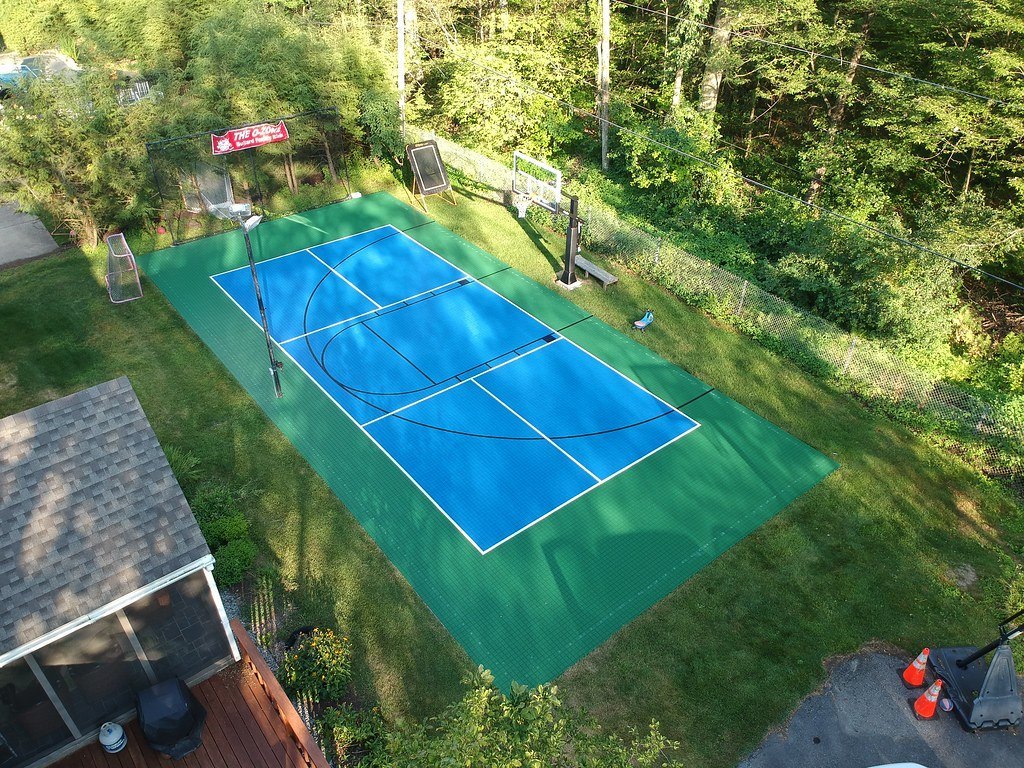
12-Dimension Comparison: Indoor vs Outdoor Pickleball Courts
Same sport, very different build requirements. Use this table to make the right decision for your project.
| Dimension | Indoor Court | Outdoor Court |
|---|---|---|
| Surface system | Elastic acrylic roll (wood floors); interlocking court tiles (concrete); acrylic court coating (long-term concrete) | Acrylic court coating (all-weather, 6-10 yr lifespan); interlocking court tiles (temporary / removable) |
| Substrate type | Wood sports floor, concrete, hardened floor | Concrete, asphalt, compacted gravel (with treatment) |
| Weather resistance | Not required — fully weather-protected | Essential — UV, freeze-thaw, rain, drainage all critical |
| Ball type | Indoor ball (softer, larger holes, slower bounce — e.g. Jugs ball) | Outdoor ball (harder, smaller holes, more durable, wind-resistant) |
| Noise management | High priority — enclosed space amplifies sound; sound-absorbing panels recommended | Moderate — noise dissipates outdoors; setback distance from residences key factor |
| Lighting | Existing building lighting usually sufficient; may need supplemental court lighting | Dedicated LED lighting system required for evening / night use |
| Drainage | Not required; indoor spill management sufficient | Critical — 1:100 surface slope required; proper drainage channels |
| Slip resistance | Standard dry-condition coefficient (0.5-0.7) | Wet-condition coefficient critical — silicon carbide texture recommended |
| Court marking | Same dimensions; line color may contrast with floor color | Same dimensions; line color typically white or yellow on colored surface |
| Maintenance cost | Lower — protected from UV and weather degradation | Higher — UV, thermal expansion, and rainfall accelerate wear |
| Construction time | 1-3 days (interlocking tiles) or 5-7 days (acrylic coating, including curing) | Same timelines; plus drainage and substrate prep if required |
| Reversibility | Interlocking tiles and elastic acrylic roll are fully removable | Acrylic court coating is permanent; interlocking tiles are removable |
Prices shown are reference figures in CNY. All pricing is subject to official quote based on actual site conditions.
Indoor Court: Recommended Surface Systems
Wood Sports Floor → Elastic Acrylic Roll
For courts built on existing wood sports floors (gyms, school halls, community centers), elastic acrylic roll is the preferred choice:
- Protects the underlying wood floor — no adhesive, no permanent modification
- Rollable for storage — roll up when the event ends, store in a corner, redeploy for the next session
- 7-layer composite structure for consistent ball bounce and good underfoot cushioning
- Competition court setup (9 × 19 m): 260 CNY/m2 reference (subject to official quote)
- Training court setup (7.2 × 15 m): 200 CNY/m2 reference (subject to official quote)
Concrete or Hardened Floor → Interlocking Court Tiles or Acrylic Court Coating
- Interlocking court tiles: 1-3 days installation, no adhesive, fully removable; ideal when the space has multiple uses
- Acrylic court coating: long-term fixed installation, lowest unit cost, 6-10 year lifespan; best when the space is dedicated to pickleball
Outdoor Court: Recommended Surface Systems
Existing Flat Hardened Concrete or Asphalt → Acrylic Court Coating
- 98 CNY/m2 all-inclusive (subject to official quote) — lowest unit cost of the three systems
- 6-10 year lifespan; UV-stable; silicon carbide texture for consistent wet-weather slip resistance
- Water-based formula, GB 18581-2020 VOC compliant
- Substrate requirement: C25+ flat hardened concrete or asphalt; not recommended below 5°C installation temperature
Temporary or Relocatable Outdoor Court → Interlocking Court Tiles
- Snap-lock assembly, no adhesive, 1-3 days to a fully playable court
- Multiple SKUs: Standard Mige PB-Entry (120 CNY/m2), Strong Mige PB-Standard (130 CNY/m2), Xingyao competition-grade (268 CNY/m2)
- UV-stabilized material for outdoor use
- Fully relocatable when the venue changes
Prices shown are reference figures in CNY. All pricing is subject to official quote based on actual site conditions.