
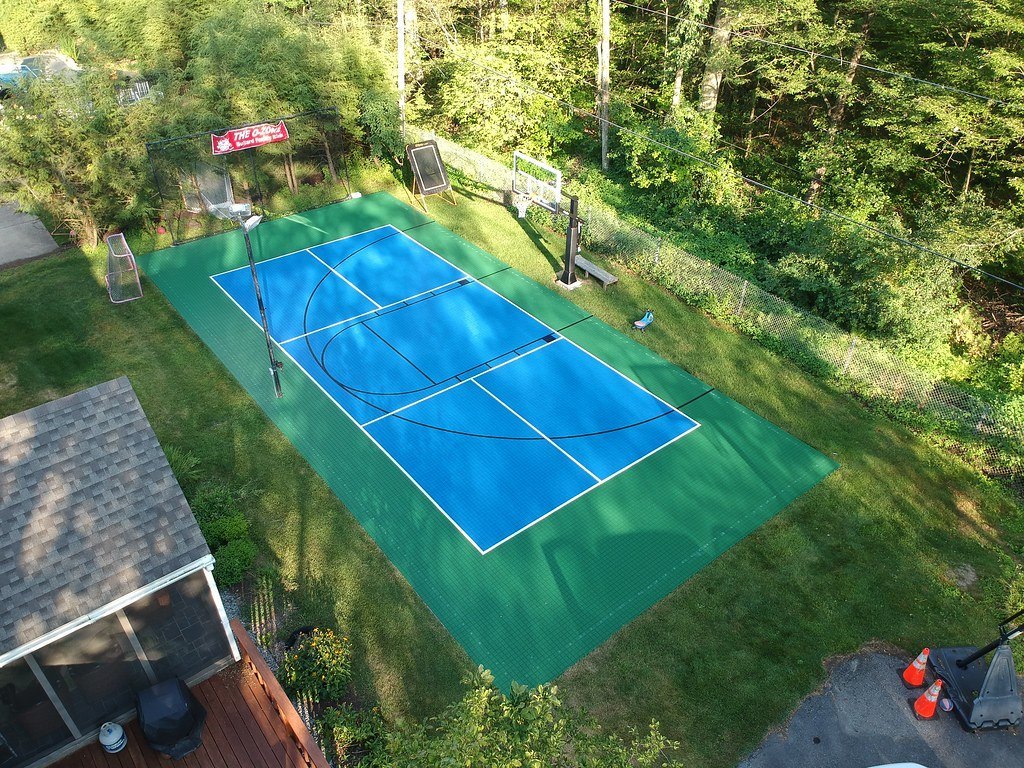
This is the question investors ask most. There is no single universal answer — it depends on your capital outlay, local pricing, utilization rate, and operating costs. But the break-even logic is fixed, and this page helps you work through it. Important disclaimer: All revenue figures, costs, and payback periods on this page are illustrative models and industry reference data, not earnings guarantees. Actual results depend on real-world operations. Please substitute your own local data before drawing conclusions.
Is a Pickleball Venue Profitable? Start with the Break-Even Logic
Whether it's profitable ultimately comes down to a single division:
` Payback period ≈ Total construction cost ÷ Annual net profit Annual net profit = Annual revenue - Annual operating costs `
As an emerging sport, pickleball has a low learning curve, strong social appeal, compact footprint, and low renovation cost — making it easier than traditional court sports to run a profitable "sport + social" high-yield-per-square-meter model. The key is maximizing revenue while keeping costs under control.
Parametric ROI Model: Run the Numbers Yourself
Replace the three parameter groups below with your real local figures, plug them into the formula, and you get your payback period.
Revenue (Annual)
` Annual court rental = Courts x Daily sellable slots x Price per slot x Utilization rate x Operating days Annual ancillary revenue = Memberships + Coaching/private lessons + Events/tournaments + Retail/rentals + Advertising Annual revenue = Annual court rental + Annual ancillary revenue `
- Number of courts: Sets the revenue ceiling and creates economies of scale (cost per court decreases as you add more).
- Sellable slots: Night lighting and covered roofs directly extend billable hours.
- Utilization rate: The most sensitive variable. Industry reference: approximately 80-95% (industry reference, not a guarantee) for mature operations — expect lower during the ramp-up phase.
- Average spend per booking: Varies by city, time slot, and pricing strategy. Dynamic pricing can raise overall yield.
Costs (Annual Operating)
` Annual operating costs = Labor + Utilities (lighting is the largest item) + Rent (if applicable) + Maintenance and resurfacing amortization + Marketing + Insurance and miscellaneous `
Reminder: Surface resurfacing is needed every few years — always include it as long-term amortization, not just first-year costs.
Capital Outlay (Total Construction Cost, CNY/court, starting from / reference only — subject to official quote)
| Tier | Full court reference (per court) |
|---|---|
| Entry-level (community/school) | approx. CNY 30,000-60,000 |
| Standard professional (club/commercial) | approx. CNY 100,000-200,000 |
| Premium/tournament-grade | CNY 200,000+ |
Converting a warehouse or existing hard surface reuses the existing foundation; industry reference suggests savings of approximately 30-40% on construction cost (industry reference, not a guarantee), significantly shortening payback. Prices shown are reference figures in CNY. All pricing is subject to official quote based on actual site conditions.
Full Worked Example (All Figures Are Hypothetical — Not Earnings Guarantees)
The following is a pure illustrative calculation. All numbers are hypothetical demonstrations only and are not intended to represent actual market conditions or earnings promises.
Hypothetical scenario: 3 standard outdoor acrylic courts with lighting, total construction cost assumed at CNY 300,000.
| Annual Revenue (hypothetical) | Amount | Annual Operating Costs (hypothetical) | Amount | |
|---|---|---|---|---|
| Walk-in court rental | CNY 180,000 | Labor | CNY 120,000 | |
| Memberships | CNY 80,000 | Utilities | CNY 40,000 | |
| Coaching / private lessons | CNY 90,000 | Rent / depreciation | CNY 60,000 | |
| Tournaments / events | CNY 30,000 | Maintenance and resurfacing amortization | CNY 20,000 | |
| Retail / advertising | CNY 20,000 | Marketing and customer acquisition | CNY 20,000 | |
| Insurance and misc. | CNY 10,000 | |||
| Total Revenue | approx. CNY 400,000 | Total Costs | approx. CNY 270,000 |
` Annual net profit ≈ 400,000 - 270,000 = CNY 130,000/year (hypothetical) Payback period ≈ 300,000 ÷ 130,000 ≈ 2.3 years (hypothetical) `
This is just one neutral hypothetical scenario. Using your own local pricing and utilization rate, results may be faster or slower — which is why the variables below are critical for you to evaluate yourself.
Key Variables That Affect Payback Speed
| Variable | How it affects payback | Investor strategy |
|---|---|---|
| Utilization rate | Most sensitive. Every step up in occupancy significantly boosts net profit | Dynamic pricing, booking system, community traffic to lift utilization |
| Average spend | Directly drives revenue | Peak-hour premium pricing; upsell coaching and retail |
| Revenue mix | Rental-only yields lower margin per square meter | Stack memberships + coaching + tournaments to build high-margin revenue |
| Construction cost | Smaller denominator = faster payback | Reuse existing foundations; bulk pricing for multiple courts |
| Operating costs | Labor and rent are the biggest items | Booking + smart-access to reduce labor; choose location to control rent |
| Ramp-up period | Early-stage revenue is lower | Build community at opening; use introductory pricing to accelerate volume |
It is advisable to model optimistic / neutral / conservative three scenarios; the payback period will fall in a range, not a single point.
Tournaments and Community Traffic: An Undervalued Payback Accelerator
Many investors only count court rental and coaching, overlooking the leverage effect of tournaments and community engagement on payback:
- Tournament momentum: Monthly member tournaments and tiered competitions drive high-frequency visits, word-of-mouth growth, and media coverage. Profit per event is secondary — new player acquisition, retention, and brand are the long-term value.
- Community virality: WeChat groups / mini-programs for court booking; peer referrals and group bookings push customer acquisition costs to near zero.
- Corporate team-building: Full-court bookings for corporate events and corporate leagues are high-value, easy-to-repeat, and fill off-peak hours.
- Social add-ons: Coffee, light bites, and photo opportunities make "sport + social" a reason to visit, extending dwell time and driving repeat purchases.
These strategies collectively raise utilization and retention — and utilization is the single most sensitive variable in the break-even model. Strong traffic truly compresses the payback period.
Industry Reference Ranges (Reference Only — Not Earnings Guarantees)
| Metric | Industry reference range | Notes |
|---|---|---|
| Court utilization rate | approx. 80-95% | For mature operations, not opening phase |
| Payback period | approx. 12-18 months and beyond | Varies greatly by investment, pricing, and utilization |
| Warehouse conversion cost savings | approx. 30-40% | By reusing existing structural foundation |
The figures above are publicly available industry reference data for illustrative purposes only. Not earnings guarantees. Actual results depend on real-world operations.
Franchise Fees and City Partner Program: Build with LOCVIN
On the question of "franchise fees" — LOCVIN offers full turnkey delivery plus three partnership models (City Partner / Construction Subcontractor / Channel Distributor), each with different levels of investment and roles. Specific terms and fee structures are discussed on a one-to-one basis.
LOCVIN (headquartered in Yongjia, Wenzhou, Zhejiang) standardizes and scales the construction piece, backed by USAP + GB + SGS standards, freeing you to focus on operations and profitability.
Ready to Act? Here Are the Next Steps
- Investment inquiry hotline: 4006065611 / 4006065611
- Email: yinyin@locvin.com
- Leave your contact details and an engineer will deliver a localized ROI analysis within 24 hours — optimistic / neutral / conservative scenarios based on your city, site, and budget.
- Further reading: Partnership Details · Solutions · Success Cases
Key fact: Court playing area 6.10 x 13.41 m; with buffer zones the minimum total court area is 9.14 x 18.29 m (30 x 60 ft). LOCVIN helps you build it right the first time for long-term operational success, turning the ROI model from paper into reality.
Common Questions
- How long to break even on a pickleball venue? Use the formula on this page with your local pricing, utilization, and costs. Industry reference payback period is approximately 12-18 months and beyond (reference only, not a guarantee); worked example shows approximately 2.3 years (hypothetical demonstration, not a guarantee).
- Is a pickleball venue profitable? Depends on revenue mix and operations. Court rental provides the base; stack memberships + coaching + tournaments + social to achieve higher margin and better returns.
- How much are franchise fees? Three partnership models correspond to different investment levels; please contact us for a one-to-one discussion.
- How to break even faster? Raise utilization (dynamic pricing + community traffic), build high-margin revenue streams (coaching/memberships), reduce construction cost (reuse existing foundations), control labor and rent.
- Who is the City Partner model for? Investors who believe in the local pickleball market, want to operate a venue, and want to reduce construction risk through standardized delivery.
Need a Site-Specific Quote?
The above are general engineering benchmarks. Actual materials, processes, and costs vary by site conditions. LOCVIN provides full turnkey pickleball court delivery. Leave your requirements and an engineer will assess them.