
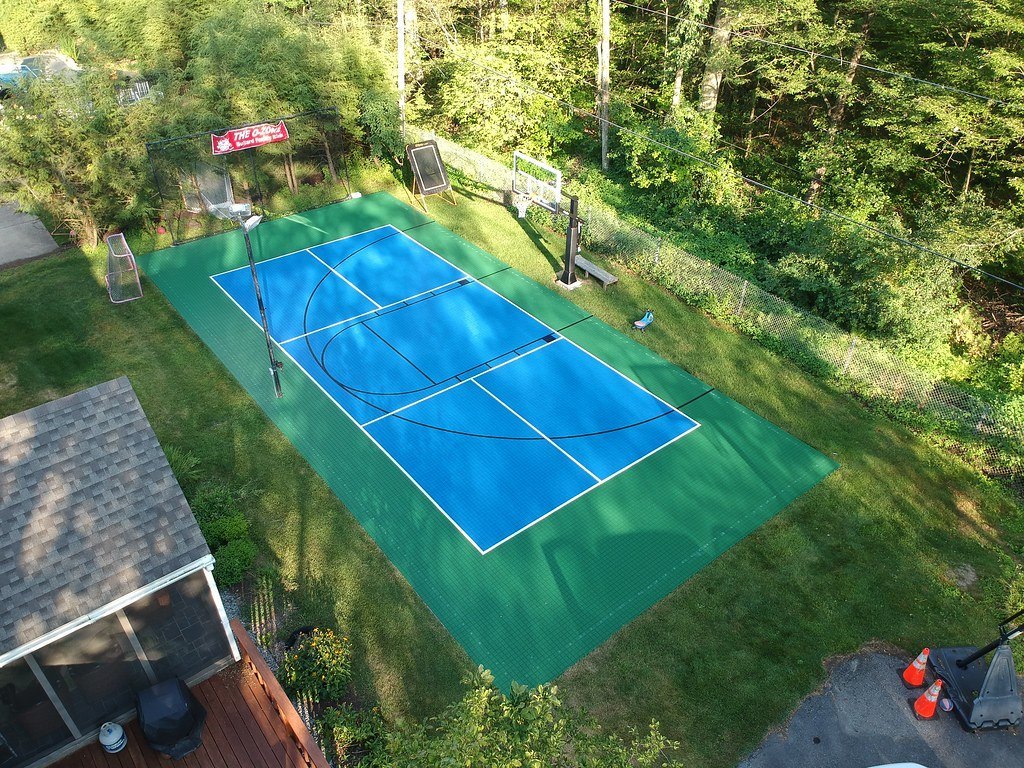
1. The Two Core Numbers: In-Bounds vs. Total Size
In-bounds fixed size: 13.4×6.1m (globally standardized). Total size includes buffer zones on all sides — adjustable to site conditions.
2. Detailed Breakdown of Court Zones
People often confuse "court size." There are two layers: the in-bounds playing area and the total footprint including buffer zones.
3. Choosing Among 4 Buffer Zone Options
In-bounds area (13.4×6.1m) is fixed. The surrounding buffer zones can be scaled to match available space and budget.
4. Which Substrate Types Are Buildable
Total size = 13.4×6.1m + perimeter buffer — buffer zones are where players run, retrieve balls, and retreat safely.
5. Three Critical Layout Verification Points
One rule: in-bounds dimensions are fixed; total dimensions depend on the buffer zone. Always quote total size when estimating area and cost.
6. LOCVIN Court Marking Service
Conversion reference: 1 ft = 30.5 cm. Official pickleball dimensions are in feet; convert to meters for domestic construction.
Pickleball Court Standard Dimensions and Marking Specifications
TL;DR / Quick Answer: Pickleball court in-bounds fixed size is 13.4×6.1m (including lines) — globally standardized, non-negotiable. Buffer zones are adjustable, with 4 width options: 6.1/7/8/9.5m. Official total court minimum: 30×60ft (9.14×18.29m); recommended: 34×64ft (10.36×19.51m). Net height: 0.914m at sideline, 0.864m at center. Full breakdown below.
Many people confuse "pickleball court size." There are actually two layers:
In-bounds area (the court itself) = 13.4×6.1m — this is the area within the court boundary lines. It is globally standardized and cannot be changed. It is nearly identical in size to a badminton doubles court.
Total size (including buffer zones) = 13.4×6.1m + perimeter buffer — the buffer zone is the space for player movement, ball retrieval, and safe retreat. It can be adjusted to suit the site.
In short: the in-bounds dimensions are fixed; the total footprint depends on the buffer zone. When quoting court area or calculating costs, always use the total size.
Conversion reference: 1 ft = 30.5 cm. Official pickleball dimensions use feet; convert to meters for domestic construction projects.
Larger buffer zones improve player experience and safety, but increase footprint and cost. LOCVIN provides 4 standard buffer zone configurations:
Official total court dimensions: minimum 30×60ft (9.14×18.29m); recommended 34×64ft (10.36×19.51m) — for multi-court venues, add standard clearance between courts on top of these dimensions.
Pickleball has far less bounce than basketball, making substrate flatness critical. Before building, assess your ground:
Substrate summary: flat, slope-free, and hard-surfaced. Any non-compliant substrate requires additional preparation — always factor that cost into the total budget.
When supervising or accepting a court build, focus on these 3 checkpoints:
Diagonal verification — measure both diagonals; both should be 14.72m (48 ft 4 in). Equal diagonals confirm a true rectangle.
Net height dual-check — 0.914m at the sideline posts, 0.864m at center. The center being lower is correct.
Non-volley zone (NVZ) line position — 2.13m from the net on each side. A misplaced NVZ line invalidates the "kitchen" rules for the entire court.
Interlocking tiles: color coding creates zone separation directly — minimal or no marking required, installed in 1–3 days.
Elastic acrylic roll: 1.8m wide rolls — installer-laid with on-site marking included.
Acrylic court coating: 7-step application process includes a dedicated marking step (12 hours curing).
Nationwide installation service. Standard court marking completed to USA Pickleball official court specifications in one visit.
Pickleball court construction is LOCVIN's core business — built on 10+ years of sports flooring R&D since 2015. Clients include MUSCO Lighting, JOOLA Outback Pickleball Central & Club, OSTATION mall chain, and WPK competition venues.
Q1: What are the standard pickleball court dimensions? A: In-bounds fixed size 13.4×6.1m (globally standardized). With buffer zones: official minimum 30×60ft (9.14×18.29m), recommended 34×64ft (10.36×19.51m).
Q2: How high is a pickleball net? A: 0.914m (36 in) at the sideline posts; 0.864m (34 in) at center — slightly lower in the middle.
Q3: Is a pickleball court the same size as a tennis court? A: No. A pickleball court in-bounds is only 13.4×6.1m — about 1/4 the size of a tennis court. One standard tennis court can be converted into 4 pickleball courts.
Q4: What is the non-volley zone (kitchen) and how large is it? A: The NVZ extends 2.13m (7ft) from the net on each side. Players inside this zone may not volley — it is the core strategic zone in pickleball.
Q5: Can I omit the buffer zone? A: The in-bounds 13.4×6.1m cannot be reduced, but buffer zones can be compressed. A residential backyard minimum can be as small as 6.1×13.5m total, though smaller buffers limit player movement and safety.
Q6: What surfaces cannot be used directly for pickleball courts? A: Grass, dirt, and soft cushioned surfaces cannot be used directly. Paving bricks, sandy concrete, and ceramic tiles require self-leveling or hardening treatment first.
Standard Mige Interlocking Tiles PB-Entry — CNY 120/m² → View product details
Competition-Grade Elastic Acrylic Roll — CNY 200–260/m² → View product details
Acrylic Court Coating (all-inclusive) — CNY 98/m² → View product details
* All prices are reference figures in CNY and subject to official quote based on actual site conditions.