
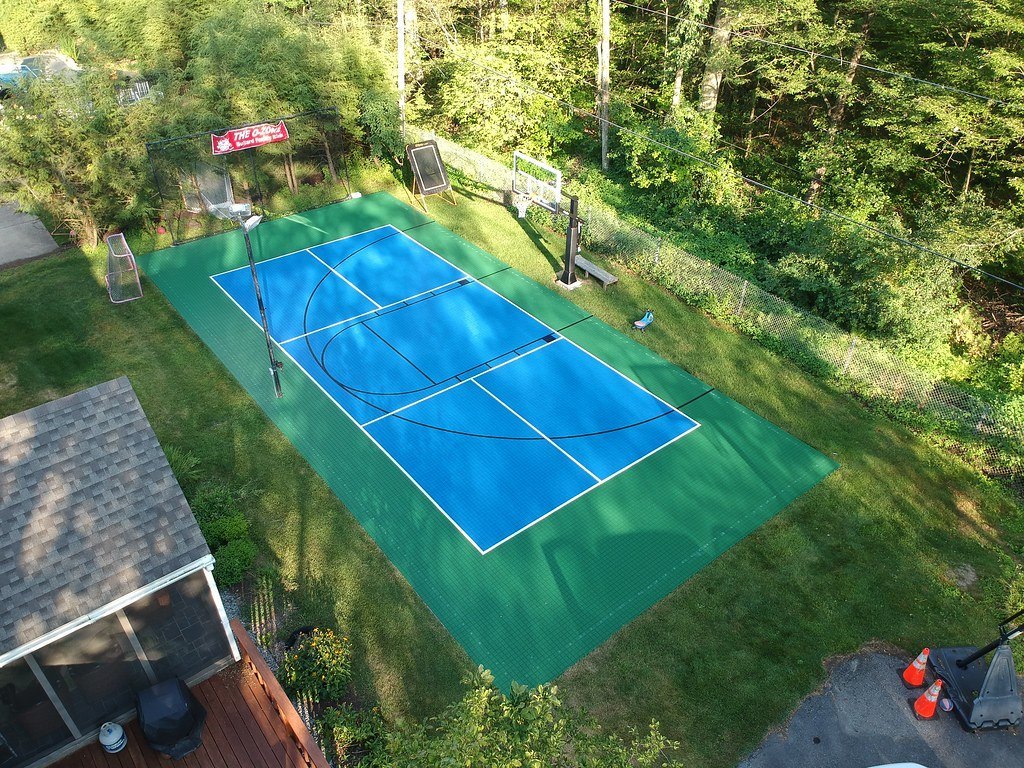
The same national standard needs to be applied differently for each climate. Southern China's heavy rainfall causes surface bubbling and algae; northern cold causes frost heave and cracking; coastal zones see salt corrosion; northwest regions face thermal expansion cracking; high altitudes accelerate UV degradation — the right choices for foundation, surface, accessories, and construction timing all shift accordingly. LOCVIN (Zhejiang Junai Technology) provides full turnkey delivery for pickleball courts, handling site assessment, foundation and drainage, surface selection, lighting, and fencing end-to-end. The safest approach is to work with a builder who knows your local climate.
1. One Table: How Climate Changes Your Court Construction Plan
| Climate Factor | Primary Impact | LOCVIN Response |
|---|---|---|
| Rainy / Humid | High drainage demand, surface bubbling, algae growth, short dry construction windows | Enhanced slope drainage, prefer interlocking court tiles, time construction for dry spells or add roof covering |
| Severe Cold / Snow | Freeze-thaw cracking, snow load on surface, short usable season | Frost-resistant foundation, code-compliant expansion joints, inflatable dome for all-weather use |
| Intense Heat / Sun | Surface aging and fading, thermal expansion, midday glare, hot underfoot | UV-resistant surface, medium-light colors to reduce heat, shade structure, north-south orientation |
| Coastal / High Salt | Metal corrosion from salt spray, high wind loads | Hot-dip galvanizing + coating, stainless steel connectors, wind-load reinforcement |
| Dry-Hot / Large Temperature Range | Significant thermal expansion/contraction, wind-blown sand abrasion | Code-compliant expansion joints, elastic surface, wind barriers |
| High Altitude / Strong UV | Rapid surface aging, player fatigue | UV-resistant surface, shade structures, shorter resurfacing intervals |
All entries above are qualitative directional references. Specific materials, methods, and dimensions must be determined by local structural/drainage design and manufacturer specifications. Need to check your site in detail? Try the Court Planner first, then have a LOCVIN engineer prepare a custom plan.
2. Rainy / Humid South China Court Construction (South China, Yangtze Delta, Southwest)
Core challenge: Heavy rain and high humidity mean outdoor courts are prone to standing water; acrylic and silicon PU wet-applied surfaces tend to bubble; algae grows in shaded damp corners; continuous dry construction windows are short.
Materials and Process Differences
- Drainage is the first priority: Proper single-direction slope (typically ~1%) is essential, along with perimeter channel drains and enlarged catch basins forming an organized drainage system. The specific cross-section must be calculated from catchment area and local storm intensity — rainy regions should use the upper range. Follow drainage calculations and drawings.
- Prefer interlocking court tiles for the surface: PP interlocking court tiles drain well, dry quickly after rain, and are low-maintenance — the most reliable choice for wet climates. Choose styles with drainage ribs / holes. LOCVIN offers Standard Mige PB-Entry starting at 120 CNY/m2, Strong Mige PB-Standard starting at 130 CNY/m2, and Xingyao competition-grade at 268 CNY/m2 (reference prices, subject to official quote).
- For acrylic / silicon PU, control substrate moisture strictly: Before wet-applied surfaces are installed, substrate moisture content must be kept low (typical benchmark is ≤8%, but varies by system — follow manufacturer's technical data sheet); apply a moisture-blocking primer to reduce bubbling risk from rising damp. LOCVIN elastic acrylic roll 200-260 CNY/m2, acrylic court coating from 98 CNY/m2 (all-inclusive, materials + labor, service life 6-10 years) — all reference prices.
Construction Season Windows
- Suitable: Dry season / extended clear spells.
- With precautions: Between plum rain events — strictly control moisture, target consecutive rain-free curing windows.
- Avoid: Continuous rain, typhoon season.
- Interlocking tile installation ~1-3 days; elastic acrylic roll ~1-2 days; acrylic coating ~5-7 days; wet-applied surfaces in particular need dry windows.
Maintenance Highlights
- Clear channel drains and catch basins before and after rainy season;
- Regularly remove algae and mold (focus on shaded damp corners); inspect for surface bubbling / hollow spots;
- Increase ventilation in humid periods (indoor / covered courts).
Want to stop being weather-dependent? Adding a canopy or fully enclosing the venue dramatically increases operational hours. LOCVIN can design covered solutions for rainy regions in our Solutions section.
3. Severe Cold / Snow Region Court Construction and Frost-Heave Prevention (Northeast, North, Northwest High-Latitude)
Core challenge: Freeze-thaw cycles cause foundation and surface cracking (frost heave); winter snow loads the surface; outdoor usable season is short.
Materials and Process Differences (Frost-Heave Prevention Focus)
- Frost-resistant foundation: Anti-heave sub-base — in permafrost zones, increase graded gravel / sand-gravel sub-base thickness and ensure good drainage to reduce pore water and minimize frost heave. Sub-base thickness calculated from local frost depth; reinforced / fiber-reinforced concrete for crack resistance.
- Code-compliant expansion joints to release thermal stress: Plain concrete slab contraction joint spacing based on slab thickness and mix design; in engineering practice 4-6 m spacing is a common range (joint depth ~1/4 to 1/3 of slab thickness), with severe cold / large temperature-range zones using the closer spacing (lower end); interlocking court tiles require perimeter expansion gaps per manufacturer specification (typically 10-20 mm per side). Follow structural design / product data sheet.
- Choose low-temperature-flexible surface systems: Interlocking tiles have thermal expansion and require proper gap sizing; for acrylic / silicon PU, choose systems with good low-temperature flexibility to avoid winter embrittlement cracking. LOCVIN Beiji Xing rollable tiles are suited for seasonal storage scenarios (inquire for pricing).
Construction Season Windows
- Suitable: Warm season, late spring through early autumn.
- With precautions: Early spring / late autumn — guard against day-night temperature swings; cover and cure.
- Avoid: Freezing periods are not suitable for concrete pours or surface application (low temperatures impair curing of concrete and surface layers).
- Rule: concrete curing ≥28 days, moisture content must be within spec before surface installation. Never rush.
Maintenance Highlights
- Clear snow promptly after snowfall — use soft plastic shovels along marking line direction; no sharp tools or corrosive de-icers (to avoid damaging surface and markings);
- Inspect for freeze-thaw cracks and re-seal expansion joints every spring;
- Check air dome blower and door seals.
Covered structure is the top choice for northern winters: inflatable air domes maintain constant temperature, install quickly, and can be dismantled seasonally — a clear advantage for cold-climate venues. LOCVIN can evaluate air dome / indoor conversion plans for projects in cold regions.
4. Intense Heat / High Sun Region Court Construction and Fade Prevention (South China, Central China Summer, Inland)
Core challenge: UV accelerates surface aging and color fading, high surface temperature underfoot, midday glare, thermal expansion/contraction.
Materials and Process Differences (Fade Prevention Focus)
- UV-resistant surface: Prioritize UV-resistant surface systems in high-sun zones. Avoid very dark colors (they absorb heat and burn feet); prefer medium-brightness cool tones (blue / blue-green); use sufficient brightness contrast between the play area and surrounding area for visibility. Color matching follows "adequate ball-to-background contrast" as the guiding principle — refer to the surface manufacturer's color chart.
- Heat reduction: Lighter colors reflect more, keeping surface temperature relatively lower; combined with shade this reduces the burning sensation underfoot. However, very light colors increase glare — use medium-light brightness to balance the two.
- Adequate expansion joints: Dark surfaces reach higher temperatures under intense sun, so gap sizing should follow manufacturer's high-temperature specification; interlocking tiles require proper gap sizing per standard.
Construction Season Windows
- Suitable: Mild spring and autumn; early morning and evening in summer.
- With precautions: Peak summer — avoid midday; guard against fast-drying surface skinning.
- Avoid: Continuous wet application during peak midday heat.
Orientation, Shade, and Maintenance
- Orientation: Long axis north-south to reduce glare (see Site Selection and Noise guide);
- Shade: Canopy improves player experience and protects the surface;
- Operating hours: Encourage early morning / evening use; extend usable hours at night with LED lighting;
- Maintenance: Regularly inspect for UV aging (fading, chalking, cracking) and high-temperature surface delamination / bubbling.
LOCVIN provides LED lighting packages; in high-sun regions, an "early morning + evening + night" operating combination can significantly increase court utilization. See real-world examples in our Experience section.
5. Coastal / Island Court Construction (High-Salt Anti-Corrosion)
Core challenge: Salt spray corrodes metal components; high wind loads.
Materials and Process Differences (Corrosion Prevention Focus)
- Dual corrosion protection for metal components: Net posts, fence posts, and light poles should prioritize hot-dip galvanizing as the base coat (thicker coating recommended for coastal zones) + topcoat; connectors, post bases, and similar hardware should use stainless steel (304 / 316 — 316 is more corrosion-resistant in high-salt coastal environments); treat embedded anchors and flange welds with corrosion protection to avoid bare spots. Specific coating thickness and system to follow corrosion protection design.
- Avoid salt-trapping dead corners: Seal metal component joints or include drainage channels; prevent water and salt accumulation in dead corners.
- Surface: Interlocking court tiles are moisture and corrosion resistant with low maintenance — widely used at coastal resort properties.
Construction Season Windows
- Suitable: Mild season with light winds.
- With precautions: Normal wind periods — secure components against wind loads.
- Avoid: Typhoon / strong wind and heavy rain periods.
Wind Resistance and Maintenance
- Wind resistance: Fencing / wind barriers / light poles reinforced per local coastal wind load; foundation and anchor sizing based on wind load calculations; tall structures such as light poles require additional verification;
- Maintenance: Regular fresh-water rinse to remove salt deposits (mandatory after strong winds / typhoons); inspect rust spots and touch up coating; tighten loose connectors.
LOCVIN fencing and accessories (e.g., competition net post LW-2 at CNY 3600, reference price) can be specified for high-salt coastal conditions, with unified corrosion protection design as part of full turnkey delivery.
6. Dry-Hot / Large Temperature Differential Court Construction (Northwest, Inland)
Core challenge: Large day-night temperature swings, dry and windy with sand, significant thermal expansion/contraction.
- Crack resistance: Set expansion joints at code spacing; prefer elastic surfaces (silicon PU / elastic acrylic) to buffer thermal stress.
- Wind and sand protection: Fencing + wind barriers block sand; regular sweeping.
- Surface: UV-resistant, tolerant of large temperature differentials.
- Construction window: Prefer transitional seasons with smaller temperature swings; during large-differential periods, cover and cure and control curing temperature; avoid sandstorm / high-wind / dust-blown periods.
- Maintenance: Regular sand and dust removal (prevents abrasion and slippage); inspect for thermally induced cracks and re-fill joints.
7. High-Altitude Court Construction
Core challenge: Intense UV, rapid surface aging, player altitude fatigue.
- Surface: UV-resistant surface; plan for shorter resurfacing / renovation intervals.
- Shade: Canopy improves player experience and protects the surface.
- Construction window: Warm-season moderate periods preferred; midday intense UV requires shade and worker protection; avoid rain/snow and nighttime low-temperature periods.
- Operations note: Account for exercise intensity at altitude; provide rest and hydration facilities.
8. Regional Adaptation Quick-Reference Table
| Region Type | Preferred Surface | Must-Do Enhancements | Cover Recommendation | Maintenance Focus | Construction Window |
|---|---|---|---|---|---|
| Rainy South | Interlocking tiles / Acrylic | Drainage, moisture control, dry-window construction | Canopy / Indoor | Clear algae, maintain drainage, inspect bubbling | Avoid rainy season; target dry spells |
| Cold North | Weather-resistant / cold-flexible surface | Anti-freeze, expansion joints, snow clearing | Air dome | Soft-shovel snow, no de-icer, inspect frost cracks | Avoid freezing-period pours and surface work |
| Intense Heat | UV-resistant (medium-light color) | Shade, N-S orientation | Shade canopy | Inspect UV fading, high-temp delamination | Avoid peak midday heat for wet work |
| Coastal High-Salt | Interlocking tiles / corrosion-resistant surface | Metal corrosion protection, wind reinforcement | As needed | Fresh-water rinse, inspect rust, tighten fasteners | Avoid typhoon season; secure against wind |
| Dry-Hot / Large Temp Range | Elastic surface | Expansion joints, wind/sand barrier | As needed | Clear sand, inspect thermal cracking | Avoid sandstorms; manage day-night temp swing |
| High Altitude / Strong UV | UV-resistant surface | Shade, shorter resurfacing intervals | Shade canopy | Inspect UV aging; provide rest/hydration | Avoid peak midday UV; protect workers |
All entries above are qualitative references; materials and methods must follow manufacturer specifications and local design standards.
9. Authority Credentials and Full Turnkey Delivery Commitment
- Standards and testing: LOCVIN surfaces and accessories are benchmarked against USAP rules and comply with GB 36246-2018 (campus facilities), GB 18581-2020 (environmental limits), and other national standards, supported by SGS testing (specific certifications subject to actual project test reports).
- Timeline reference: Interlocking 1-3 days / elastic acrylic roll 1-2 days / acrylic coating 5-7 days (depending on site conditions and weather).
- Warranty reference: Interlocking tiles 8 years (Elite grade 6 years) / elastic acrylic roll 3 years / acrylic coating service life 6-10 years.
- Full turnkey delivery: From site assessment, foundation drainage, surface, lighting, fencing through to accessories — one point of contact, no multi-party disputes.
10. Why Choose a Builder Who Knows Your Local Climate?
Every climate-adaptation detail — how many percent to slope the surface, whether expansion joints should be tighter or wider, how thick the galvanizing, what moisture content to target, which season to avoid — cannot simply be looked up in a table and copied. It must be determined based on your local storm intensity, frost depth, wind loads, UV intensity, and seasonal patterns. A contractor unfamiliar with local climate is most likely to get these "invisible" details wrong, leading to post-construction bubbling, frost cracking, corrosion, or fading.
LOCVIN is headquartered in Yongjia, Wenzhou, Zhejiang, and serves all climate zones nationwide. We can produce a customized full-site plan tailored to your local climate, and take responsibility for timelines, warranties, and materials end-to-end.
Contact an Engineer Now
- Phone: 4006065611
- Email: yinyin@locvin.com
- Address: Yangwan Industrial Zone, Yongjia County, Wenzhou, Zhejiang
Recommended next steps: 1. Use the Court Planner to test-layout your site; 2. Browse your climate region's complete solution in Solutions; 3. Share your site city and photos so a LOCVIN engineer can provide a climate-tailored quote and construction window recommendation.
Related reading: Knowledge Center overview · Pickleball Noise and Site Selection guide · Construction Process · FAQ
Need This Applied to Your Specific Project?
The above is general engineering guidance; specific materials, processes, and costs vary with site conditions. LOCVIN provides full turnkey pickleball court delivery — share your requirements and our engineer will assess the site.