
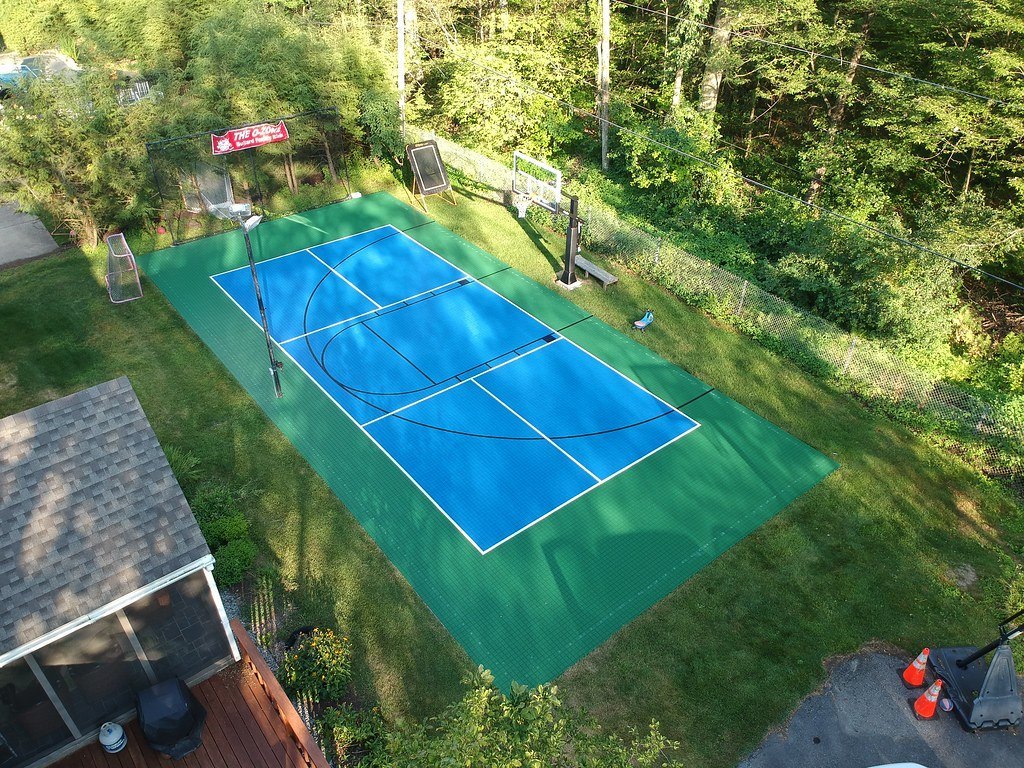
1. Court Dimensions and Total Area
Playing area 20x44 ft; minimum total area 30x60, recommended 34x64 ft; buffer zones behind baselines and alongside sidelines.
2. Court Zones and Lines
Non-volley zone (kitchen), service area, centerline; line width 2 in; diagonal verification.
3. Net Specifications
Net length, post spacing, dual-point height measurement, post diameter and top binding.
4. Orientation and Multi-Court Layout
Outdoor courts oriented N-S to avoid direct low-angle sun; multi-court spacing requirements.
5. Substrate and Surface System
Concrete/asphalt hardened substrate, drainage slope, 100% acrylic surface system and optional cushion layer.
6. Fencing, Safety, and Lighting
Back and side fencing heights, mesh size, windscreen, gates, lighting reference values.
1. Court Dimensions and Total Area
Playing area (inside sidelines) = 20x44 ft (6.10m x 13.41m)Official — applies to both singles and doubles; universal worldwide and cannot be changed.
Beyond the playing area, buffer zones must be provided on all sides (space for player movement, ball retrieval, and safety clearance). When quoting area and calculating costs, use the "total court area."
| Item | Imperial | Metric (approx.) | Notes |
|---|---|---|---|
| Playing area | 20 x 44 ft | 6.10 x 13.41 m | Inside sidelines; universal worldwide |
| Minimum total area | 30 x 60 ft | 9.14 x 18.29 m | Minimum recommended total area per official guide |
| Recommended total area | 34 x 64 ft | 10.36 x 19.51 m | Preferred total area per official guide |
Per USA Pickleball official construction guide: playing area 20x44 ft; minimum total area 30x60 ft, recommended 34x64 ft. Larger buffer zones improve player experience and safety but increase land use and cost. Actual dimensions subject to site conditions and formal design.
2. Court Zones and Lines
The court interior is divided into the NVZ and left/right service areas by the centerline and NVZ line. All lines are included within the playing area dimensions.
| Zone / Item | Specification | Source |
|---|---|---|
| Non-volley zone (kitchen) | 7 ft (2.13m) from the net on each side, spanning the full width between sidelines | Official |
| Service area | Between NVZ line and baseline, divided into left and right zones by centerline | Official |
| Line width | 2 in (5.08cm) | Official |
| Diagonal measurement | Approx. 48 ft 4 in (14.73m); both diagonals must be equal for a true rectangle | Verification method |
NVZ of 7 ft from net and 2-in line width are official specifications. The 14.73m diagonal is derived from the 20x44 ft rectangle by the Pythagorean theorem — a standard layout-verification value; an error here throws off all kitchen-zone rules.
3. Net Specifications
The net is by design slightly lower at the center than at the posts — this is normal. The following are officially specified dimensions.
| Item | Specification | Metric (approx.) |
|---|---|---|
| Net length (post to post) | At least 21 ft 9 in | ≥ 6.63 m |
| Post spacing | 22 ft | 6.71 m |
| Net height at sideline posts | 36 in | 0.914 m |
| Net height at center | 34 in | 0.864 m |
| Net width (top to bottom) | At least 30 in | ≥ 0.76 m |
| Post diameter | No more than 3 in | ≤ 7.6 cm |
| Top binding | 2-in white binding | 5.08 cm |
All values above are per the USA Pickleball official construction guide. During inspection, measure net height at two points: posts at 0.914m and center at 0.864m.
4. Court Orientation and Multi-Court Layout
- Outdoor orientationOfficial — The court's long axis should be oriented N-S, preventing players from facing low-angle sun, which affects serving, receiving, and safety.
- Multi-court layoutIndustry practice — Adjacent courts require safety clearance and passage space between them; court dividers may be used. Specific spacing depends on total site area and circulation design.
- Color zoningIndustry practice — Multi-court facilities may use different colors to distinguish playing areas, non-volley zones, and buffer zones, improving visual clarity.
N-S outdoor orientation is explicitly stated in the official construction guide. Multi-court spacing and color zoning are common engineering practices, not fixed official values.
5. Substrate and Surface System
Substrate
- Hardened substrateOfficial — Any firm hardened surface (concrete or asphalt) is acceptable as an outdoor competition substrate; must be flat, clean, free of sandy or hollow areas.
- Drainage slopeIndustry practice — Outdoor courts require a single-direction drainage slope (industry common practice approx. 1%, i.e., approx. 10cm drop per 10m). The official construction guide does not specify an exact slope value; refer to actual drainage engineering design.
- Crack treatmentOfficial — Existing cracks in old substrates may be treated with acrylic crack filler or a multi-layer fabric long-life crack repair system before the surface coating is applied.
Surface System
- 100% acrylic surface systemOfficial — Professional courts are recommended to use a 100% acrylic coating system, which is breathable and allows some moisture vapor transmission — especially important for outdoor courts.
- Optional cushion layerOfficial — A cushioned layer may be added beneath the surface coating to provide shock absorption without affecting ball bounce. Cushion levels are available in standard and enhanced options.
Substrate and surface specifications are per the USA Pickleball official construction guide; third-party brand names have been removed, retaining only generic technical specifications. Specific materials and thicknesses subject to formal project design.
6. Fencing, Safety, and Lighting
Fencing and Safety
| Item | Specification | Source |
|---|---|---|
| Back fence (behind baselines) | Minimum 10 ft (approx. 3.05m) | Official |
| Side fence (alongside sidelines) | Not less than 3 ft (approx. 0.91m) | Official |
| Mesh size | Recommended 45mm or 55mm | Official |
| Windscreen | Recommended; provides wind blocking and viewing backdrop | Official |
| Gate | Must be wide enough for wheelchair and maintenance equipment passage | Official |
Lighting
- The USA Pickleball official construction guide does not specify illuminance values.Industry practice
- Common industry references: recreational play approx. 300 lux (30 fc); training / competition approx. 500 lux (50 fc) or above. Pole height, fixture position, and uniformity per professional lighting design.
Back fencing ≥10 ft, side fencing ≥3 ft, 45/55mm mesh, windscreen, and wheelchair-accessible gates are all officially specified. Illuminance values are industry references only — not listed in the official construction guide — and must be verified by a lighting design engineer.
Frequently Asked Questions
Q1: What are the standard pickleball court playing area dimensions?
A: 20x44 ft (6.10x13.41m), including lines — universal worldwide and cannot be changed.
Q2: How much total area is needed to build one court?
A: Official minimum recommended total area is 30x60 ft (9.14x18.29m); 34x64 ft (10.36x19.51m) is more recommended. Buffer zones can be compressed to fit site conditions, but smaller buffers reduce player movement space and safety margins.
Q3: How high is the net?
A: 36 in (0.914m) at the sideline posts; 34 in (0.864m) at center — a slightly lower center is by design.
Q4: How large is the non-volley zone (kitchen)?
A: 7 ft (2.13m) on each side of the net, spanning the full width between sidelines. Players standing in this zone may not volley the ball.
Q5: Which substrates can be built on directly?
A: Flat, hardened concrete or asphalt can receive the surface system directly. Grass, dirt, or cushioned soft surfaces cannot. Sandy concrete, ceramic tile, and paving brick require hardening treatment or self-leveling compound first.
Q6: Why should outdoor courts be oriented N-S?
A: Orienting the court's long axis N-S prevents players from facing low-angle sun, reducing glare and improving safety for serving and receiving.
LOCVIN Court Construction Services
LOCVIN delivers pickleball courts to the above official specifications with full turnkey delivery: substrate assessment and preparation, surface system (interlocking court tiles / elastic acrylic roll / acrylic court coating), standard court marking, perimeter fencing and lighting, net frame, and operational consumables — all included.
- Interlocking court tiles — color-coded zones built into the tiles; 1-3 day installation
- Elastic acrylic roll system — on-site installation and court marking available
- Hard court / elastic acrylic court coating — includes dedicated court marking step
- LED lighting and perimeter fencing / net frame accessories
Standards on this page are compiled from the USA Pickleball official construction guide; third-party brand names have been removed. All values are subject to the latest official documents and formal engineering design.
Let Our Professional Team Handle Your Court Construction
Leave your basic requirements and our engineers will contact you within 24 hours to provide one-on-one surface selection assessment and preliminary quote.