
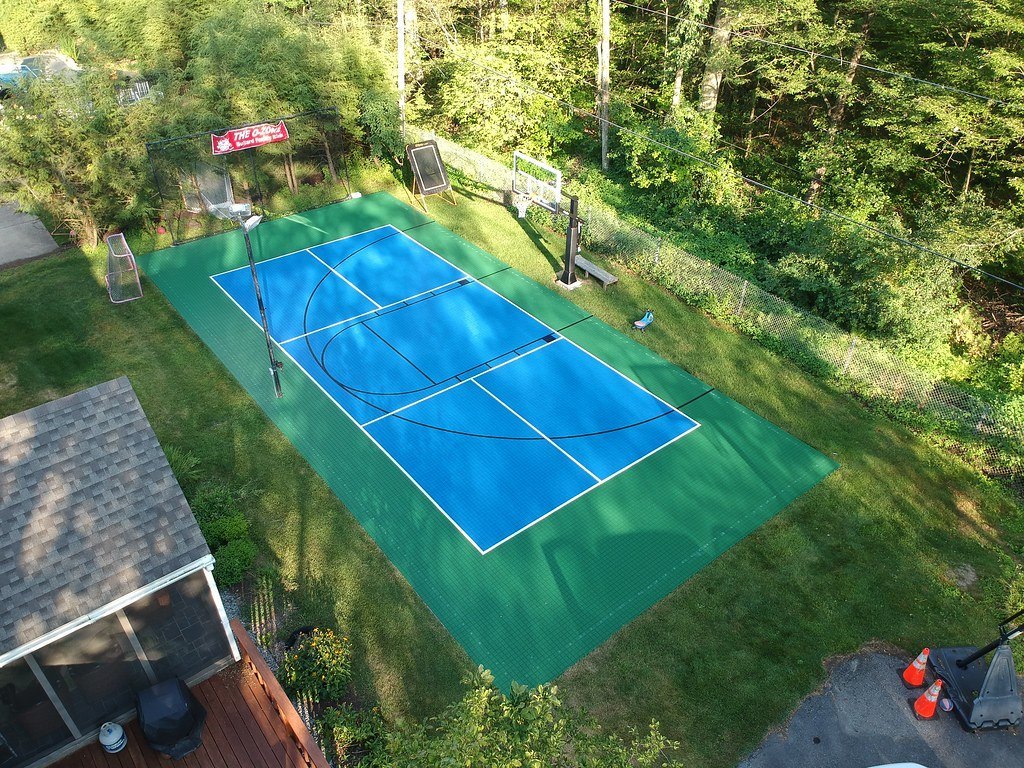
Why convert a tennis court?
Pickleball demand is surging while many tennis courts sit underused. A tennis court can fit 4 pickleball courts — dramatically increasing utilization and revenue per square meter.
3 conversion methods compared
Method A: acrylic court coating (most popular); Method B: interlocking court tiles (reversible, fast); Method C: elastic acrylic roll (temporary). Each has different cost, timeline and permanence.
Court dimension reference
Tennis court: 23.77x10.97 m (260.87 m2). Pickleball court: 13.4x6.1 m (81.74 m2) + 3 m buffer recommended on each end. A tennis court comfortably fits 2-4 pickleball courts.
5 key construction tips
Check substrate flatness, re-mark lines, use color-coded courts, replace net posts, reuse fencing and lighting. Substrate preparation is the most critical — and often overlooked — step.
Frequently asked questions
Net height differences, cost ranges, timeline, reversibility and common mistakes — all addressed in the FAQ section below.
Get a conversion quote
Share your court size, current substrate type and target use. Our engineers will provide a detailed conversion proposal within 24 hours.
Tennis vs Pickleball Court Dimensions
| Court Type | Length | Width | Total Area |
|---|---|---|---|
| Standard tennis court | 23.77 m | 10.97 m | ~260.87 m2 |
| Pickleball court (playing area) | 13.41 m | 6.10 m | ~81.74 m2 |
| Pickleball court (recommended with buffers) | 19.51 m | 9.14 m | ~178.3 m2 |
| Net height at posts | 1.07 m (tennis) | 0.914 m (pickleball) | Different |
| Net height at center | 0.914 m (tennis) | 0.864 m (pickleball) | Different |
| Non-volley zone (NVZ) | N/A | 2.13 m (7 ft) from net | Pickleball only |
A standard tennis court at ~260 m2 can fit approximately 2-4 pickleball courts depending on how much buffer zone is allocated and whether courts run parallel or perpendicular to the tennis baseline. With minimal buffer (minimum USAP recommended), 4 courts can be squeezed in; with full recommended buffers, 2 courts with comfortable play space.
3 Conversion Methods
Method A: Acrylic Court Coating
All-inclusive materials + labor (subject to official quote). Apply acrylic court coating directly over existing hardened concrete or asphalt base. Surface is permanently changed; new pickleball lines applied over old tennis markings using high-contrast color differentiation. Most popular conversion method — fast, durable, low maintenance.
Method B: Interlocking Court Tiles
Lay modular interlocking court tiles directly over existing base — no adhesive, no demolition. 1-3 days installation (substrate ready). Fully reversible — tiles can be removed and relocated. Strong Mige competition-grade from 130 CNY/m2. Subject to official quote based on actual conditions.
Method C: Elastic Acrylic Roll
Rollable elastic acrylic roll system — temporary, reversible overlay option. Can be laid without adhesive for event use, or bonded for semi-permanent installation. Provides cushioning and color differentiation. Suitable for venues testing pickleball before committing to permanent conversion.
5 Key Construction Tips
- Check substrate flatness first. Existing tennis courts can develop drainage slopes, cracks or height deviations over time. Substrate preparation — patching, leveling and crack filling — is the most critical step for long-term coating adhesion and tile stability. LOCVIN includes free substrate assessment before quoting.
- Re-mark lines in high-contrast colors. Old tennis lines remain visible under acrylic overlay. New pickleball lines must use a clearly different color (e.g., white lines on a blue-green playing area, with kitchen zone in a distinct contrasting color) to avoid player confusion.
- Color-code courts if fitting multiple pickleball courts. When fitting 3-4 pickleball courts on one tennis court, each court's non-volley zone should use a distinct color or the court orientations should make boundaries unmistakable. Clear boundary delineation prevents disputes during casual play.
- Replace net posts (or add adjusters). Pickleball center height (0.864 m) differs from tennis (0.914 m). Use a dedicated pickleball net frame — either portable or permanent. Existing perimeter fencing and lighting poles are typically fully reusable.
- Reuse existing fencing and lighting where possible. Tennis court fencing is typically 3-4 m high — higher than minimum pickleball requirements — but this can be left in place and is actually an advantage for ball containment. Existing lighting can be reconfigured or supplemented with targeted LED additions to meet pickleball-specific horizontal/vertical illuminance requirements.
Frequently Asked Questions
How many pickleball courts fit on one tennis court?
One standard tennis court (~23.77x10.97 m) fits approximately 2-4 standard pickleball courts (each 13.4x6.1 m). With extra clearance, typically 2-4 courts are laid out depending on the buffer zone and fencing configuration.
Does converting a tennis court to pickleball require demolition?
No demolition required. The existing hardened concrete or asphalt base can be reused directly — just apply acrylic court coating overlay or lay interlocking court tiles on top.
How much does conversion cost?
Acrylic court coating overlay starts from around 98 CNY/m2 (all-inclusive, subject to official quote). Interlocking court tile overlay starts from around 120 CNY/m2 (Standard Mige, subject to official quote). Prices depend on substrate condition, court count and local logistics.
How long does conversion take?
For interlocking court tile overlay: as little as 1-3 days depending on court count and crew size. For acrylic coating, typically 3-7 days including curing time. Substrate preparation time varies by condition.
Can the converted court be changed back to tennis?
Interlocking court tile overlay is fully reversible — tiles can be removed and the original surface restored. Acrylic coating overlay permanently changes the surface color and markings, but the underlying base remains intact.
Do the tennis net posts need to be replaced?
Pickleball net height (0.914 m at posts, 0.864 m at center) differs from tennis (1.07 m at posts, 0.914 m at center). A dedicated pickleball net frame is recommended. Existing perimeter fencing and lighting can generally be reused.