
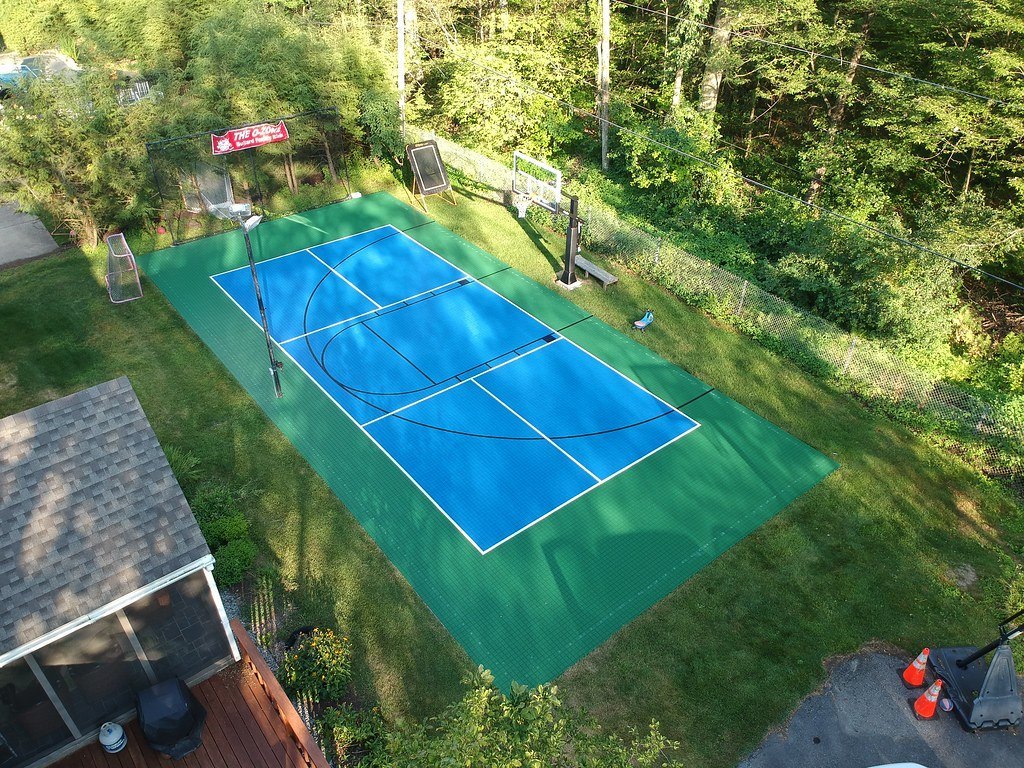
1. Concrete vs Asphalt: Which Foundation to Choose?
The two most common foundation materials for outdoor pickleball courts are concrete and asphalt. The table below summarizes the key differences:
| Item | Concrete (Recommended) | Asphalt |
|---|---|---|
| Service Life | 20-30 years or more | 10-15 years |
| Structural Stability | Excellent, not prone to rutting | Prone to high-temperature softening and rutting |
| Construction Difficulty | Standard, requires 28-day curing | Faster, usable in 1-2 days |
| Maintenance Cost | Low | Medium to high, periodic resealing needed |
| Suitability for Court Coating | High compatibility with acrylic coating | Compatible, but surface pretreatment required to prevent oil bleeding |
| Recommendation | Preferred for new builds | Acceptable for renovations with adequate budget and surface assessment |
Note: Asphalt foundations are more common in some regions due to local material costs and construction conditions. Both are supported — final recommendation subject to site assessment.
2. New Concrete Foundation: Layer-by-Layer Specifications
A standard pickleball court concrete foundation is built from the ground up in the following layers:
| Layer (Bottom to Top) | Material / Specification | Key Requirement |
|---|---|---|
| ① Compacted Soil Subgrade | Native soil or imported fill | Compaction coefficient ≥0.93; no loose soil or organics |
| ② Gravel Sub-base | Crushed stone or graded gravel, thickness 10-15cm | Improves drainage and bearing capacity; prevents frost heave |
| ③ Moisture Barrier | PE film or waterproof membrane | Prevents ground moisture from migrating upward into slab |
| ④ Concrete Slab | Strength ≥C25, thickness ≥10cm (commonly 10-13cm) | Steel mesh or fiber concrete reinforcement; curing ≥28 days; flatness: 3m ruler ≤3mm |
| ⑤ Leveling / Interface Layer | Self-leveling or acrylic primer coat (as needed) | Fills minor surface imperfections; enhances bonding for surface system |
| ⑥ Surface System | Acrylic coating / elastic acrylic roll / interlocking court tiles | Select based on project requirements and budget |
Core Concrete Specifications
- Strength grade: ≥C25 (i.e., compressive strength ≥25 MPa). Lower grades are susceptible to surface dusting and cracking.
- Thickness: ≥10cm; commonly 10-13cm; areas with vehicle access should be 15-20cm.
- Reinforcement: Use steel mesh (diameter 6-8mm, grid 150-200mm) or polypropylene fiber concrete to control cracking.
- Curing: ≥28 days natural curing; moisture-cure or wet-burlap curing when needed; avoid early loading.
- Flatness: 3m straight edge ≤3mm deviation; single-direction drainage slope ≈1% (1:100).
3. Drainage Slope Design: ≈1% Single-Direction Slope
A pickleball court must drain efficiently after rain. Drainage design follows a strict rule — this is one of the most overlooked foundations of court quality:
- Slope specification: ≈1% (1:100), i.e., 1cm of fall per 100cm of run.
- Direction: Single direction only — water drains toward one side or corner. Double-direction (bi-slope) designs are prohibited.
- Bowl-bottom design prohibited: Slopes that cause water to pool in the center will lead to surface coating delamination.
- Perimeter drainage: Set a channel or French drain at the low side to collect and discharge runoff.
- Slope tolerance: Actual slope should be between 0.8%-1.2%; outside this range will impair drainage or ball bounce consistency.
Note: The slope is built into the concrete slab, not corrected by the surface coating. Once the concrete sets, slope errors cannot be corrected by the surface layer alone.
4. Expansion Joints and Control Joints
Concrete undergoes thermal expansion and contraction. Joints must be designed properly to prevent uncontrolled cracking:
- Control joints: Spaced every 3-6m, depth approximately 1/4 of slab thickness (typically 2.5-3cm). These guide crack formation along planned lines.
- Expansion joints: Installed at boundaries between the court and surrounding structures (walls, columns, adjacent slabs). Filled with elastic sealant.
- Joint filling: Use polyurethane or silicone sealant to keep joints watertight while allowing movement.
- Court surface alignment: The surface coating system must not bridge over expansion joints — joints must be expressed through the finished surface.
5. Existing Surface Assessment: 5-Point 3-Tier System
When renovating an existing court (old tennis court, basketball court, or deteriorated surface), perform a 5-point assessment before deciding on the treatment approach:
| Assessment Point | Tier 1 (Minor) | Tier 2 (Moderate) | Tier 3 (Severe) |
|---|---|---|---|
| Crack Width | <0.5mm, surface only | 0.5-2mm, through-slab | >2mm, active movement |
| Hollow / Delamination | <5% of area | 5-20% of area | >20% of area |
| Sandy Surface / Strength | Surface dust only | Surface laitance, strength reduced | Aggregate exposure, strength compromised |
| Flatness | 3m ruler ≤5mm | 3m ruler 5-10mm | 3m ruler >10mm |
| Drainage | Good, no ponding | Minor ponding, drainage slow | Persistent ponding, drainage failed |
Treatment Decision by Tier
- Tier 1 (Minor): Surface cleaning + crack sealing + primer application → proceed with surface system.
- Tier 2 (Moderate): Mechanical grinding + crack repair + self-leveling leveling compound → proceed with surface system after re-assessment.
- Tier 3 (Severe): Partial or full slab demolition and reconstruction. New-build specifications apply.
6. Moisture Testing Before Surface Application
Moisture in the concrete slab is the most common cause of acrylic coating delamination. Before any coating is applied, moisture content must be tested:
Plastic Film Cover Method (Based on ASTM D4263 Approach)
- Cut a 45x45cm sheet of clear PE plastic film.
- Tape all four edges to the concrete surface, forming a sealed chamber.
- Wait 16-24 hours.
- Remove film and inspect: if condensation or water droplets are present on the underside of the film, the slab moisture is too high.
- Standard: no visible condensation. If condensation is present, delay coating application and allow further drying.
Additional method: calcium chloride emission test or in-situ relative humidity probe. The plastic film method is the most practical for field use.
Note: New concrete must cure for a minimum of 28 days before coating. High-humidity climates or shaded areas may require longer drying time.
7. Foundation Pre-Handover Inspection Checklist (9 Items)
Before the surface coating crew takes over from the civil contractor, the following 9-point inspection must be completed and signed off:
- 1. Flatness: 3m straight edge ≤3mm deviation across the entire court area.
- 2. Drainage slope: ≈1% single-direction, verified by level instrument or water test.
- 3. Expansion/control joint integrity: All joints filled with elastic sealant, no open gaps, no crumbling edges.
- 4. Anchor/embed positions: Net post anchor sleeves and fencing post footings at correct positions and depths.
- 5. Surface cleanliness: Free of oil, dust, laitance, curing compound residue, and construction debris.
- 6. Moisture content: Plastic film test pass (no condensation); slab age ≥28 days.
- 7. Surface strength: No sanding, no hollow areas; Schmidt hammer rebound value meets C25 standard.
- 8. Settlement and cracking: No new active cracks; no differential settlement exceeding 5mm.
- 9. Horizontal level: Overall court level difference from design elevation ≤±10mm.
All 9 items must pass before the surface system installation begins. Proceeding with a non-compliant foundation invalidates any surface warranty.
8. Summary: Foundation Is the Hidden Engineering Core
The quality of a pickleball court surface is not determined by the paint or tiles alone — it is determined by what lies beneath. A well-engineered foundation guarantees:
- Consistent ball bounce across the entire court surface.
- Freedom from delamination, bubbling, and cracking within the warranty period.
- Long-term drainage performance that keeps the court playable after rain.
- Safe footing without trip hazards caused by differential settlement.
LOCVIN's engineering team provides on-site foundation assessment as part of the pre-project service. Contact us for a project-specific evaluation and proposal.